Buying an Aircraft? Don’t Let the Dream Take Off Without the Right Checks

September 2026 Edition

This is a subtitle for your new post

Buying an aircraft can be an exciting milestone, whether it is for business, recreation or private use. But aircraft purchases are not like buying a car or boat. They involve technical records, regulatory requirements and airworthiness considerations that may not be obvious at first glance.


Imagine purchasing an aircraft only to later discover it is not airworthy. If a buyer assumes the right checks have already been completed, they may be left facing unexpected costs, delays and legal uncertainty after settlement.


It is an important reminder that what looks right on the surface may not always tell the full story. A well-presented aircraft is not necessarily compliant, airworthy or free from risk.


Why a pre-purchase inspection matters

A pre-purchase inspection can help identify issues with the aircraft’s condition, maintenance history and airworthiness before the buyer commits. It can also highlight questions that should be addressed in the sale agreement.


The key is knowing what has been checked, what has not been checked, and what protections are in place if something is discovered later.


Things to consider before purchasing an aircraft

  •  Arrange an independent inspection before committing to the purchase.
  • Review key records, including logbooks, maintenance history and relevant compliance documents.
  • Confirm the aircraft’s airworthiness status rather than relying on assumptions or verbal assurances.
  • Use a written sale agreement that clearly sets out the terms, inclusions and inspection rights.
  • Seek advice before signing, particularly if finance, insurance, ownership structures or regulatory issues are involved.


What if problems are discovered after purchase?

If issues are discovered after settlement, the buyer’s options will depend on the contract, what was represented before the sale and the nature of the defect. These matters can become complicated quickly, especially where technical aircraft records and regulatory requirements are involved.


How CJM Lawyers can help

At CJM Lawyers, our aviation law team assists with aircraft sale and purchase agreements, due diligence, ownership structures, finance and security arrangements, leasing, regulatory issues and disputes.


If you are thinking about buying an aircraft, we can help you understand the legal considerations before you commit. If you have already purchased an aircraft and something has gone wrong, we can help determine your options and advise on the best way forward.


Disclaimer: This article provides general information only and does not constitute legal advice. The information may not apply to your circumstances and should not be relied on as a substitute for tailored legal advice. If you need advice, please contact CJM Lawyers to speak with one of our legal professionals.

Contact Us Now!

For comprehensive legal services, 
book now for your free initial consultation.

Contact Us

Book Now!

Property & Conveyancing
Guarantor  Advice
Commercial & Business
Wills and Estates
Building Disputes
Employment Law
Corporate & Commercial 
Litigation
Regulatory Compliance
Immigration
Litigation
Insolvency & Bankruptcy

Contact Us Now!

For comprehensive legal services, 
book now for your free initial consultation.

Contact Us

Book Us Now!

Property & Conveyancing
Guarantor  Advice
Commercial & Business
Wills and Estates
Building Disputes
Employment Law
Corporate & Commercial 
Litigation
Regulatory Compliance
Retail & commercial leasing, business transactions, company & trust sales, property development, guarantor advice

Our Latest Story

By September 2026 Edition 3 September 2026
September is a timely reminder to pause and ask a simple but important question: does your Will still reflect your life today? For many people, making a Will is one of those important jobs that sits on the “I’ll get to it one day” list. Others may have a Will in place, but it was prepared years ago and has not been reviewed since. The challenge is that life rarely stays the same. Relationships change, families grow, property is bought or sold, businesses evolve, and financial arrangements can become more complex over time. Why reviewing your Will matters A Will is not just a document for later in life. It is an important part of planning ahead and making sure your wishes are clearly recorded. It allows you to decide who should receive your assets, who should administer your estate, and how you would like important personal matters handled. Having a valid and up-to-date Will can also make things much clearer for your loved ones at an already difficult time. It can reduce the risk of confusion about who should make decisions, who should benefit from your estate, and how your wishes should be carried out. When should you review your Will? It may be time to review your Will if you have recently: married, separated or divorced welcomed children or grandchildren bought or sold property started or sold a business moved into a blended family arrangement experienced a significant change in your finances It is also worth checking whether your superannuation nominations, enduring power of attorney and other estate planning documents still work together with your Will. What your Will may not automatically cover One common misconception is that a Will automatically covers everything you own. In reality, assets such as superannuation, jointly owned property, trusts, company interests and life insurance may need separate consideration. Without the right planning, there can be uncertainty, delays, disputes or outcomes that do not reflect what you intended. How CJM Lawyers can help At CJM Lawyers, our Wills and Estates team can help you prepare a new Will, review an existing Will, update your estate planning documents, and consider how your broader arrangements fit together. Whether your circumstances are simple or more complex, we can provide clear, practical guidance to help you plan ahead with confidence and give your loved ones greater peace of mind. Contact our Wills and Estates team today to get started. Disclaimer: This article provides general information only and does not constitute legal advice. The information may not apply to your circumstances and should not be relied on as a substitute for tailored legal advice. If you need advice, please contact CJM Lawyers to speak with one of our legal professionals.
By Charlotte Sly | Associate 10 August 2026
The process of selling a horse can be chaotic and emotional, and often people do not realise the legal implications that come along with a sale which can last into the future. There are several factors which should be taken into consideration early on to ensure the process runs smoothly, and you are not caught by surprise down the track. Representations Representations are statements made to describe the horse. This could be its temperament, behavioural history, riding suitability or soundness. In most sales, representations are initially made in the horse’s advertisement post but also continue through text messages or calls with potential buyers, and statements made in person. Each of these representations have the capacity to be used against you in the future, if the matter results in a dispute. It is common practice for sellers to describe the horse in a positive way to entice buyers to interact with the sale ad, however it is important to ensure statements made can be supported by evidence, and to understand the meaning behind the words used to describe the horse. A blanket statement such as, “a pleasure to ride” is a representation that the horse is easy and enjoyable to ride, which has no specificity and makes no allowance for any ‘quirks’ the horse may have. A horse that is a pleasure to ride in the arena, but spooky or excitable when ridden off property, should be described as such in an open and easy to understand manner. Australian Consumer Law Some horse sales may be subject to Australian Consumer Law, particularly where the seller is selling horses as part of a business or commercial activity, rather than as a one-off private sale. To identify which category you fall into, consider whether the sale of horses is a regularly repeated exercise for the purpose of making a profit. In the alternative, selling your child’s pony because they have outgrown them, as a one-off sale, would generally not be considered a commercial activity. When Australian Consumer Law applies, the buyer may have certain protections, including around the horse’s quality, condition and whether any known issues were properly disclosed. There is also a requirement that the horse is fit for any disclosed purpose. If a buyer were to advise you that they were looking for a horse for their young, beginner child to take show jumping, and you proceed with the sale, you have an obligation to ensure the horse is suitable for that purpose.  Consumer guarantees apply to most purchases of goods, however there is a monetary threshold of $100,000.00. Purchases exceeding that amount remain covered if they are acquired for personal or domestic use. The sale of highly trained performance horses may exceed the threshold amount, but in the event the horse is being acquired for personal use, the sale will generally still be required to comply with consumer guarantees. As each situation is different, it is important to seek advice about how these obligations may apply to your circumstances. To minimise risk and to prioritise a successful sale, you should make your own enquiries as to the suitability of your horse for a potential buyer. By asking them about their experience and intended use for the horse, particularly in writing, you will minimise the risk of inadvertently selling them an unsuitable horse, and you will be able to evidence your efforts to create a successful partnership. Contract of Sale A properly drafted contract is one of the best ways to minimise risk when selling a horse. By having one, you can ensure that representations made by you are clearly documented, and that the buyer signs to agree to those representations. You cannot contract out of your legal obligations under Australian Consumer Law to describe the horse accurately and correctly, but your contract can ensure there is clear record of what was agreed between the parties. This will include the purchase price and any deposit payable, the buyer’s opportunity to arrange a vet check and trainer assessment prior to purchase, and any conditions around the period between execution and purchase, such as ongoing agistment or a trial period. Your sale contract can also define key terms such as when the purchase price becomes payable, the timing that risk passes from the seller to the buyer, and what will occur if the horse is unsuitable, and the buyer wishes to return it. In many cases, the sale process is not instantaneous, and your contract of sale will provide you protection throughout the time from signing to the horse being collected, and into the future. A contract of sale additionally acts as evidence of ownership in circumstances where the horse may not be otherwise registered to record ownership, or for the time whilst you are waiting for registration to complete. Evidence of ownership may be required to obtain insurance over the horse, to secure agistment in some circumstances, or for resale purposes in the future. Managing buyer enquiries, negotiations and paperwork can feel overwhelming, especially when selling your horse is already an emotional decision. Getting advice early can help you identify risks before they become problems, clearly record what has been agreed, and move through the process with greater confidence and peace of mind. If you are preparing to sell a horse and want to feel confident before finalising the arrangement, contact CJM Lawyers to discuss how we can help. Disclaimer: This article provides general information only and does not constitute legal advice. The information may not apply to your circumstances and should not be relied on as a substitute for tailored legal advice. If you need advice, please contact CJM Lawyers to speak with one of our legal professionals.
By Nagisa Kumagai | Associate & Conveyancing Practice Manager 30 July 2026
Buying or selling property is a major decision at any time, but in a changing market, the legal details can become even more important. When prices shift, finance conditions tighten, buyer confidence changes or properties take longer to sell, both buyers and sellers may feel pressure to make quick decisions. That pressure can lead to important legal issues being overlooked. A buyer may be tempted to sign a contract before finance is formally approved or before building and pest inspection concerns are resolved or before understanding the effect of special conditions. A seller may accept unusual conditions, a delayed settlement or a request for a price reduction without fully understanding the legal and practical consequences. First home buyers may feel this pressure more strongly. Higher borrowing costs, changing government incentives, transfer duty concessions and broader cost-of-living pressures can make it harder to enter the market, and may lead some buyers to move quickly once they find a suitable property. Even in a competitive market, it is important to understand the contract terms, finance condition, building and pest conditions, any applicable cooling-off periods, special conditions and key dates before signing. This is why legal advice should be considered early in the transaction, not simply at the end before settlement. The contract, disclosure material, special conditions and key dates can all affect your rights, obligations and overall risk. For buyers, the main issue is making sure the contract gives you the protection you need before you commit. Depending on the relevant State or Territory and the terms of the contract, this may include finance approval, building and pest inspections, settlement timing, inclusions and exclusions, special conditions and any disclosure documents that raise concerns. Depending on the State or Territory, buyers may also need to consider any applicable cooling-off rights, whether those rights apply, termination costs or penalties, title issues, easements, covenants, encumbrances, strata, body corporate or owner’s corporation information, transfer duty and available concessions. If these matters are not checked before signing, your options may become limited and important deadlines may be missed. For sellers, the key issue is preparation. In a cautious or competitive market, missing documents, unresolved title issues, strata, body corporate or owner’s corporation matters, easements, unapproved structures, tenancy issues, pool safety requirements or incorrect information can create delay, renegotiation or disputes. Having the contract and disclosure material prepared before listing can help reduce these risks. State-based requirements also need to be considered. Property rules differ across Australia, including cooling-off periods, disclosure obligations, contract requirements and settlement processes. This is particularly relevant for clients buying or selling across the border, or investors purchasing outside their usual location. Recent legal changes have added another layer of risk. In Queensland, the seller disclosure scheme that commenced on 1 August 2025 generally requires sellers to give buyers prescribed disclosure material before a contract is signed, subject to exceptions. Non-compliance may give rise to buyer termination rights before settlement in some circumstances. In New South Wales, prescribed contract notices and warning statements, including cooling-off notices, should be checked to ensure the current form is used. These changes highlight why relying on outdated contracts, templates or assumptions can create unnecessary risk. Requirements in other States and Territories may also differ, so contracts and disclosure documents should be checked for the relevant jurisdiction. Legal advice can also help during negotiation. In a changing market, buyers may seek more time, more protection or a lower price after inspections. Sellers may need to decide whether to accept those requests or negotiate different terms. A lawyer can help you understand what is reasonable, what may create delay or uncertainty and what should be addressed before the contract becomes binding. At CJM Lawyers, our property team can help you identify and manage these issues from the beginning. We can review or prepare contracts, advise on disclosure obligations, explain special conditions, assist with conveyancing and assist with property transactions across Australia, including jurisdiction-specific advice and settlement coordination where required. Our role is to help you understand what you are agreeing to, identify potential problems early and make informed decisions with confidence. Whether you are buying, selling or negotiating contract terms, early legal advice can help reduce the risk of delay, dispute or costly mistakes. If you are planning to buy or sell property in 2026, contact CJM Lawyers to discuss how our property team can assist with your transaction. Disclaimer: This article provides general information only and does not constitute legal advice. The information may not apply to your circumstances and should not be relied on as a substitute for tailored legal advice. If you need advice, please contact CJM Lawyers to speak with one of our legal professionals.
Show More

Our Latest Story

By September 2026 Edition 3 September 2026
September is a timely reminder to pause and ask a simple but important question: does your Will still reflect your life today? For many people, making a Will is one of those important jobs that sits on the “I’ll get to it one day” list. Others may have a Will in place, but it was prepared years ago and has not been reviewed since. The challenge is that life rarely stays the same. Relationships change, families grow, property is bought or sold, businesses evolve, and financial arrangements can become more complex over time. Why reviewing your Will matters A Will is not just a document for later in life. It is an important part of planning ahead and making sure your wishes are clearly recorded. It allows you to decide who should receive your assets, who should administer your estate, and how you would like important personal matters handled. Having a valid and up-to-date Will can also make things much clearer for your loved ones at an already difficult time. It can reduce the risk of confusion about who should make decisions, who should benefit from your estate, and how your wishes should be carried out. When should you review your Will? It may be time to review your Will if you have recently: married, separated or divorced welcomed children or grandchildren bought or sold property started or sold a business moved into a blended family arrangement experienced a significant change in your finances It is also worth checking whether your superannuation nominations, enduring power of attorney and other estate planning documents still work together with your Will. What your Will may not automatically cover One common misconception is that a Will automatically covers everything you own. In reality, assets such as superannuation, jointly owned property, trusts, company interests and life insurance may need separate consideration. Without the right planning, there can be uncertainty, delays, disputes or outcomes that do not reflect what you intended. How CJM Lawyers can help At CJM Lawyers, our Wills and Estates team can help you prepare a new Will, review an existing Will, update your estate planning documents, and consider how your broader arrangements fit together. Whether your circumstances are simple or more complex, we can provide clear, practical guidance to help you plan ahead with confidence and give your loved ones greater peace of mind. Contact our Wills and Estates team today to get started. Disclaimer: This article provides general information only and does not constitute legal advice. The information may not apply to your circumstances and should not be relied on as a substitute for tailored legal advice. If you need advice, please contact CJM Lawyers to speak with one of our legal professionals.
By Charlotte Sly | Associate 10 August 2026
The process of selling a horse can be chaotic and emotional, and often people do not realise the legal implications that come along with a sale which can last into the future. There are several factors which should be taken into consideration early on to ensure the process runs smoothly, and you are not caught by surprise down the track. Representations Representations are statements made to describe the horse. This could be its temperament, behavioural history, riding suitability or soundness. In most sales, representations are initially made in the horse’s advertisement post but also continue through text messages or calls with potential buyers, and statements made in person. Each of these representations have the capacity to be used against you in the future, if the matter results in a dispute. It is common practice for sellers to describe the horse in a positive way to entice buyers to interact with the sale ad, however it is important to ensure statements made can be supported by evidence, and to understand the meaning behind the words used to describe the horse. A blanket statement such as, “a pleasure to ride” is a representation that the horse is easy and enjoyable to ride, which has no specificity and makes no allowance for any ‘quirks’ the horse may have. A horse that is a pleasure to ride in the arena, but spooky or excitable when ridden off property, should be described as such in an open and easy to understand manner. Australian Consumer Law Some horse sales may be subject to Australian Consumer Law, particularly where the seller is selling horses as part of a business or commercial activity, rather than as a one-off private sale. To identify which category you fall into, consider whether the sale of horses is a regularly repeated exercise for the purpose of making a profit. In the alternative, selling your child’s pony because they have outgrown them, as a one-off sale, would generally not be considered a commercial activity. When Australian Consumer Law applies, the buyer may have certain protections, including around the horse’s quality, condition and whether any known issues were properly disclosed. There is also a requirement that the horse is fit for any disclosed purpose. If a buyer were to advise you that they were looking for a horse for their young, beginner child to take show jumping, and you proceed with the sale, you have an obligation to ensure the horse is suitable for that purpose.  Consumer guarantees apply to most purchases of goods, however there is a monetary threshold of $100,000.00. Purchases exceeding that amount remain covered if they are acquired for personal or domestic use. The sale of highly trained performance horses may exceed the threshold amount, but in the event the horse is being acquired for personal use, the sale will generally still be required to comply with consumer guarantees. As each situation is different, it is important to seek advice about how these obligations may apply to your circumstances. To minimise risk and to prioritise a successful sale, you should make your own enquiries as to the suitability of your horse for a potential buyer. By asking them about their experience and intended use for the horse, particularly in writing, you will minimise the risk of inadvertently selling them an unsuitable horse, and you will be able to evidence your efforts to create a successful partnership. Contract of Sale A properly drafted contract is one of the best ways to minimise risk when selling a horse. By having one, you can ensure that representations made by you are clearly documented, and that the buyer signs to agree to those representations. You cannot contract out of your legal obligations under Australian Consumer Law to describe the horse accurately and correctly, but your contract can ensure there is clear record of what was agreed between the parties. This will include the purchase price and any deposit payable, the buyer’s opportunity to arrange a vet check and trainer assessment prior to purchase, and any conditions around the period between execution and purchase, such as ongoing agistment or a trial period. Your sale contract can also define key terms such as when the purchase price becomes payable, the timing that risk passes from the seller to the buyer, and what will occur if the horse is unsuitable, and the buyer wishes to return it. In many cases, the sale process is not instantaneous, and your contract of sale will provide you protection throughout the time from signing to the horse being collected, and into the future. A contract of sale additionally acts as evidence of ownership in circumstances where the horse may not be otherwise registered to record ownership, or for the time whilst you are waiting for registration to complete. Evidence of ownership may be required to obtain insurance over the horse, to secure agistment in some circumstances, or for resale purposes in the future. Managing buyer enquiries, negotiations and paperwork can feel overwhelming, especially when selling your horse is already an emotional decision. Getting advice early can help you identify risks before they become problems, clearly record what has been agreed, and move through the process with greater confidence and peace of mind. If you are preparing to sell a horse and want to feel confident before finalising the arrangement, contact CJM Lawyers to discuss how we can help. Disclaimer: This article provides general information only and does not constitute legal advice. The information may not apply to your circumstances and should not be relied on as a substitute for tailored legal advice. If you need advice, please contact CJM Lawyers to speak with one of our legal professionals.
By Nagisa Kumagai | Associate & Conveyancing Practice Manager 30 July 2026
Buying or selling property is a major decision at any time, but in a changing market, the legal details can become even more important. When prices shift, finance conditions tighten, buyer confidence changes or properties take longer to sell, both buyers and sellers may feel pressure to make quick decisions. That pressure can lead to important legal issues being overlooked. A buyer may be tempted to sign a contract before finance is formally approved or before building and pest inspection concerns are resolved or before understanding the effect of special conditions. A seller may accept unusual conditions, a delayed settlement or a request for a price reduction without fully understanding the legal and practical consequences. First home buyers may feel this pressure more strongly. Higher borrowing costs, changing government incentives, transfer duty concessions and broader cost-of-living pressures can make it harder to enter the market, and may lead some buyers to move quickly once they find a suitable property. Even in a competitive market, it is important to understand the contract terms, finance condition, building and pest conditions, any applicable cooling-off periods, special conditions and key dates before signing. This is why legal advice should be considered early in the transaction, not simply at the end before settlement. The contract, disclosure material, special conditions and key dates can all affect your rights, obligations and overall risk. For buyers, the main issue is making sure the contract gives you the protection you need before you commit. Depending on the relevant State or Territory and the terms of the contract, this may include finance approval, building and pest inspections, settlement timing, inclusions and exclusions, special conditions and any disclosure documents that raise concerns. Depending on the State or Territory, buyers may also need to consider any applicable cooling-off rights, whether those rights apply, termination costs or penalties, title issues, easements, covenants, encumbrances, strata, body corporate or owner’s corporation information, transfer duty and available concessions. If these matters are not checked before signing, your options may become limited and important deadlines may be missed. For sellers, the key issue is preparation. In a cautious or competitive market, missing documents, unresolved title issues, strata, body corporate or owner’s corporation matters, easements, unapproved structures, tenancy issues, pool safety requirements or incorrect information can create delay, renegotiation or disputes. Having the contract and disclosure material prepared before listing can help reduce these risks. State-based requirements also need to be considered. Property rules differ across Australia, including cooling-off periods, disclosure obligations, contract requirements and settlement processes. This is particularly relevant for clients buying or selling across the border, or investors purchasing outside their usual location. Recent legal changes have added another layer of risk. In Queensland, the seller disclosure scheme that commenced on 1 August 2025 generally requires sellers to give buyers prescribed disclosure material before a contract is signed, subject to exceptions. Non-compliance may give rise to buyer termination rights before settlement in some circumstances. In New South Wales, prescribed contract notices and warning statements, including cooling-off notices, should be checked to ensure the current form is used. These changes highlight why relying on outdated contracts, templates or assumptions can create unnecessary risk. Requirements in other States and Territories may also differ, so contracts and disclosure documents should be checked for the relevant jurisdiction. Legal advice can also help during negotiation. In a changing market, buyers may seek more time, more protection or a lower price after inspections. Sellers may need to decide whether to accept those requests or negotiate different terms. A lawyer can help you understand what is reasonable, what may create delay or uncertainty and what should be addressed before the contract becomes binding. At CJM Lawyers, our property team can help you identify and manage these issues from the beginning. We can review or prepare contracts, advise on disclosure obligations, explain special conditions, assist with conveyancing and assist with property transactions across Australia, including jurisdiction-specific advice and settlement coordination where required. Our role is to help you understand what you are agreeing to, identify potential problems early and make informed decisions with confidence. Whether you are buying, selling or negotiating contract terms, early legal advice can help reduce the risk of delay, dispute or costly mistakes. If you are planning to buy or sell property in 2026, contact CJM Lawyers to discuss how our property team can assist with your transaction. Disclaimer: This article provides general information only and does not constitute legal advice. The information may not apply to your circumstances and should not be relied on as a substitute for tailored legal advice. If you need advice, please contact CJM Lawyers to speak with one of our legal professionals.
Show More

Our Latest Story

By September 2026 Edition 3 September 2026
September is a timely reminder to pause and ask a simple but important question: does your Will still reflect your life today? For many people, making a Will is one of those important jobs that sits on the “I’ll get to it one day” list. Others may have a Will in place, but it was prepared years ago and has not been reviewed since. The challenge is that life rarely stays the same. Relationships change, families grow, property is bought or sold, businesses evolve, and financial arrangements can become more complex over time. Why reviewing your Will matters A Will is not just a document for later in life. It is an important part of planning ahead and making sure your wishes are clearly recorded. It allows you to decide who should receive your assets, who should administer your estate, and how you would like important personal matters handled. Having a valid and up-to-date Will can also make things much clearer for your loved ones at an already difficult time. It can reduce the risk of confusion about who should make decisions, who should benefit from your estate, and how your wishes should be carried out. When should you review your Will? It may be time to review your Will if you have recently: married, separated or divorced welcomed children or grandchildren bought or sold property started or sold a business moved into a blended family arrangement experienced a significant change in your finances It is also worth checking whether your superannuation nominations, enduring power of attorney and other estate planning documents still work together with your Will. What your Will may not automatically cover One common misconception is that a Will automatically covers everything you own. In reality, assets such as superannuation, jointly owned property, trusts, company interests and life insurance may need separate consideration. Without the right planning, there can be uncertainty, delays, disputes or outcomes that do not reflect what you intended. How CJM Lawyers can help At CJM Lawyers, our Wills and Estates team can help you prepare a new Will, review an existing Will, update your estate planning documents, and consider how your broader arrangements fit together. Whether your circumstances are simple or more complex, we can provide clear, practical guidance to help you plan ahead with confidence and give your loved ones greater peace of mind. Contact our Wills and Estates team today to get started. Disclaimer: This article provides general information only and does not constitute legal advice. The information may not apply to your circumstances and should not be relied on as a substitute for tailored legal advice. If you need advice, please contact CJM Lawyers to speak with one of our legal professionals.
By Charlotte Sly | Associate 10 August 2026
The process of selling a horse can be chaotic and emotional, and often people do not realise the legal implications that come along with a sale which can last into the future. There are several factors which should be taken into consideration early on to ensure the process runs smoothly, and you are not caught by surprise down the track. Representations Representations are statements made to describe the horse. This could be its temperament, behavioural history, riding suitability or soundness. In most sales, representations are initially made in the horse’s advertisement post but also continue through text messages or calls with potential buyers, and statements made in person. Each of these representations have the capacity to be used against you in the future, if the matter results in a dispute. It is common practice for sellers to describe the horse in a positive way to entice buyers to interact with the sale ad, however it is important to ensure statements made can be supported by evidence, and to understand the meaning behind the words used to describe the horse. A blanket statement such as, “a pleasure to ride” is a representation that the horse is easy and enjoyable to ride, which has no specificity and makes no allowance for any ‘quirks’ the horse may have. A horse that is a pleasure to ride in the arena, but spooky or excitable when ridden off property, should be described as such in an open and easy to understand manner. Australian Consumer Law Some horse sales may be subject to Australian Consumer Law, particularly where the seller is selling horses as part of a business or commercial activity, rather than as a one-off private sale. To identify which category you fall into, consider whether the sale of horses is a regularly repeated exercise for the purpose of making a profit. In the alternative, selling your child’s pony because they have outgrown them, as a one-off sale, would generally not be considered a commercial activity. When Australian Consumer Law applies, the buyer may have certain protections, including around the horse’s quality, condition and whether any known issues were properly disclosed. There is also a requirement that the horse is fit for any disclosed purpose. If a buyer were to advise you that they were looking for a horse for their young, beginner child to take show jumping, and you proceed with the sale, you have an obligation to ensure the horse is suitable for that purpose.  Consumer guarantees apply to most purchases of goods, however there is a monetary threshold of $100,000.00. Purchases exceeding that amount remain covered if they are acquired for personal or domestic use. The sale of highly trained performance horses may exceed the threshold amount, but in the event the horse is being acquired for personal use, the sale will generally still be required to comply with consumer guarantees. As each situation is different, it is important to seek advice about how these obligations may apply to your circumstances. To minimise risk and to prioritise a successful sale, you should make your own enquiries as to the suitability of your horse for a potential buyer. By asking them about their experience and intended use for the horse, particularly in writing, you will minimise the risk of inadvertently selling them an unsuitable horse, and you will be able to evidence your efforts to create a successful partnership. Contract of Sale A properly drafted contract is one of the best ways to minimise risk when selling a horse. By having one, you can ensure that representations made by you are clearly documented, and that the buyer signs to agree to those representations. You cannot contract out of your legal obligations under Australian Consumer Law to describe the horse accurately and correctly, but your contract can ensure there is clear record of what was agreed between the parties. This will include the purchase price and any deposit payable, the buyer’s opportunity to arrange a vet check and trainer assessment prior to purchase, and any conditions around the period between execution and purchase, such as ongoing agistment or a trial period. Your sale contract can also define key terms such as when the purchase price becomes payable, the timing that risk passes from the seller to the buyer, and what will occur if the horse is unsuitable, and the buyer wishes to return it. In many cases, the sale process is not instantaneous, and your contract of sale will provide you protection throughout the time from signing to the horse being collected, and into the future. A contract of sale additionally acts as evidence of ownership in circumstances where the horse may not be otherwise registered to record ownership, or for the time whilst you are waiting for registration to complete. Evidence of ownership may be required to obtain insurance over the horse, to secure agistment in some circumstances, or for resale purposes in the future. Managing buyer enquiries, negotiations and paperwork can feel overwhelming, especially when selling your horse is already an emotional decision. Getting advice early can help you identify risks before they become problems, clearly record what has been agreed, and move through the process with greater confidence and peace of mind. If you are preparing to sell a horse and want to feel confident before finalising the arrangement, contact CJM Lawyers to discuss how we can help. Disclaimer: This article provides general information only and does not constitute legal advice. The information may not apply to your circumstances and should not be relied on as a substitute for tailored legal advice. If you need advice, please contact CJM Lawyers to speak with one of our legal professionals.
By Nagisa Kumagai | Associate & Conveyancing Practice Manager 30 July 2026
Buying or selling property is a major decision at any time, but in a changing market, the legal details can become even more important. When prices shift, finance conditions tighten, buyer confidence changes or properties take longer to sell, both buyers and sellers may feel pressure to make quick decisions. That pressure can lead to important legal issues being overlooked. A buyer may be tempted to sign a contract before finance is formally approved or before building and pest inspection concerns are resolved or before understanding the effect of special conditions. A seller may accept unusual conditions, a delayed settlement or a request for a price reduction without fully understanding the legal and practical consequences. First home buyers may feel this pressure more strongly. Higher borrowing costs, changing government incentives, transfer duty concessions and broader cost-of-living pressures can make it harder to enter the market, and may lead some buyers to move quickly once they find a suitable property. Even in a competitive market, it is important to understand the contract terms, finance condition, building and pest conditions, any applicable cooling-off periods, special conditions and key dates before signing. This is why legal advice should be considered early in the transaction, not simply at the end before settlement. The contract, disclosure material, special conditions and key dates can all affect your rights, obligations and overall risk. For buyers, the main issue is making sure the contract gives you the protection you need before you commit. Depending on the relevant State or Territory and the terms of the contract, this may include finance approval, building and pest inspections, settlement timing, inclusions and exclusions, special conditions and any disclosure documents that raise concerns. Depending on the State or Territory, buyers may also need to consider any applicable cooling-off rights, whether those rights apply, termination costs or penalties, title issues, easements, covenants, encumbrances, strata, body corporate or owner’s corporation information, transfer duty and available concessions. If these matters are not checked before signing, your options may become limited and important deadlines may be missed. For sellers, the key issue is preparation. In a cautious or competitive market, missing documents, unresolved title issues, strata, body corporate or owner’s corporation matters, easements, unapproved structures, tenancy issues, pool safety requirements or incorrect information can create delay, renegotiation or disputes. Having the contract and disclosure material prepared before listing can help reduce these risks. State-based requirements also need to be considered. Property rules differ across Australia, including cooling-off periods, disclosure obligations, contract requirements and settlement processes. This is particularly relevant for clients buying or selling across the border, or investors purchasing outside their usual location. Recent legal changes have added another layer of risk. In Queensland, the seller disclosure scheme that commenced on 1 August 2025 generally requires sellers to give buyers prescribed disclosure material before a contract is signed, subject to exceptions. Non-compliance may give rise to buyer termination rights before settlement in some circumstances. In New South Wales, prescribed contract notices and warning statements, including cooling-off notices, should be checked to ensure the current form is used. These changes highlight why relying on outdated contracts, templates or assumptions can create unnecessary risk. Requirements in other States and Territories may also differ, so contracts and disclosure documents should be checked for the relevant jurisdiction. Legal advice can also help during negotiation. In a changing market, buyers may seek more time, more protection or a lower price after inspections. Sellers may need to decide whether to accept those requests or negotiate different terms. A lawyer can help you understand what is reasonable, what may create delay or uncertainty and what should be addressed before the contract becomes binding. At CJM Lawyers, our property team can help you identify and manage these issues from the beginning. We can review or prepare contracts, advise on disclosure obligations, explain special conditions, assist with conveyancing and assist with property transactions across Australia, including jurisdiction-specific advice and settlement coordination where required. Our role is to help you understand what you are agreeing to, identify potential problems early and make informed decisions with confidence. Whether you are buying, selling or negotiating contract terms, early legal advice can help reduce the risk of delay, dispute or costly mistakes. If you are planning to buy or sell property in 2026, contact CJM Lawyers to discuss how our property team can assist with your transaction. Disclaimer: This article provides general information only and does not constitute legal advice. The information may not apply to your circumstances and should not be relied on as a substitute for tailored legal advice. If you need advice, please contact CJM Lawyers to speak with one of our legal professionals.
Show More

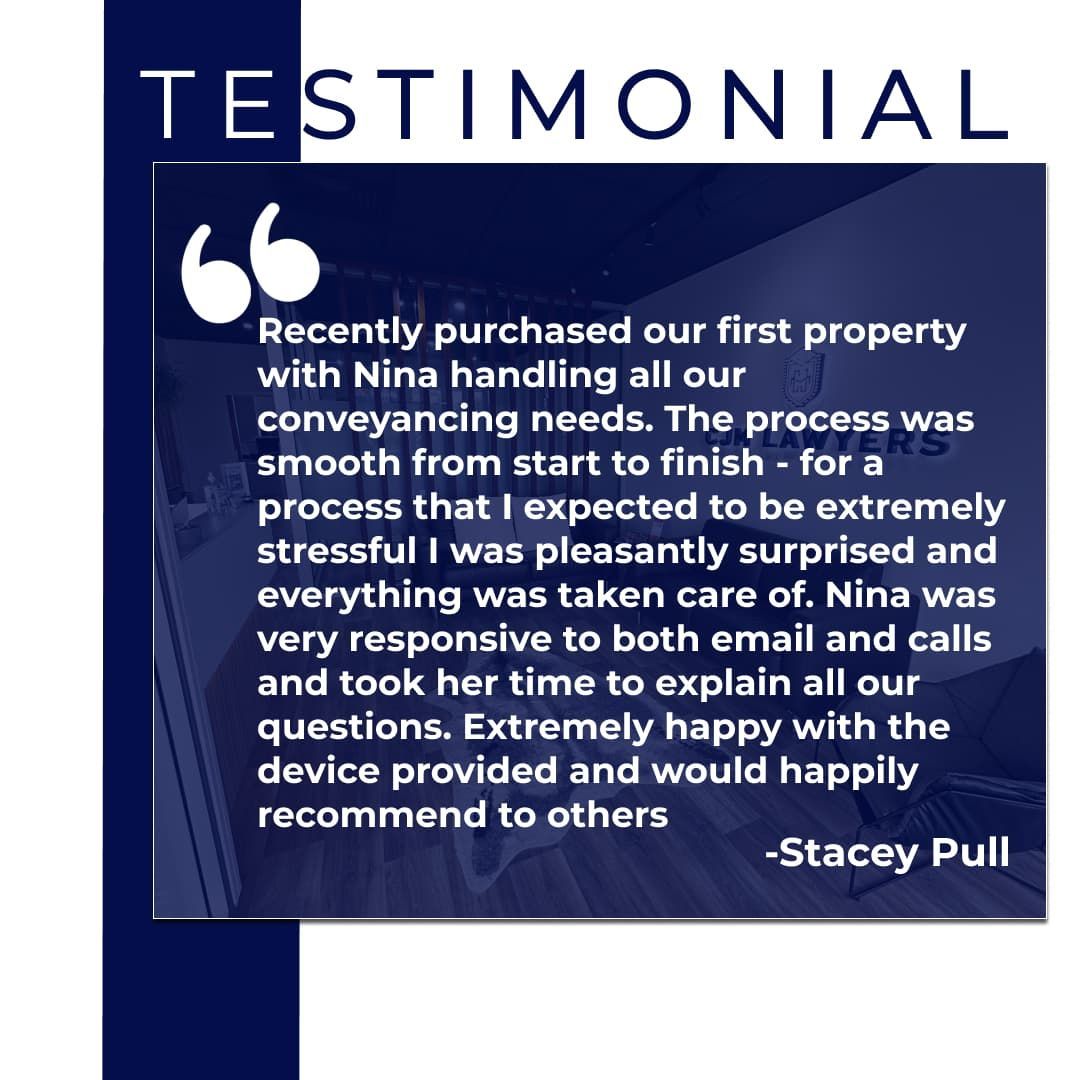
Our Client Say

Our Client Say

Our Client Say